

The diamond wire saw machine—also known as the diamond bead saw—represents the most advanced equipment currently available for stone extraction. It has been widely adopted across the stone, machinery, and construction sectors, primarily utilized for the quarrying and processing of stone, the demolition and trimming of reinforced concrete structures, and the processing of hard, brittle materials such as glass.
Process Requirements for Diamond Wire Saw Machines
The diamond wire saw machine employs a main motor to drive the saw wire along an approximately racetrack-shaped trajectory. The saw wire is threaded through pre-drilled holes in the surface designated for cutting; subsequently, the main motor—acting through a speed reducer—drives the entire saw unit to move backward along the cutting plane at a specific speed.
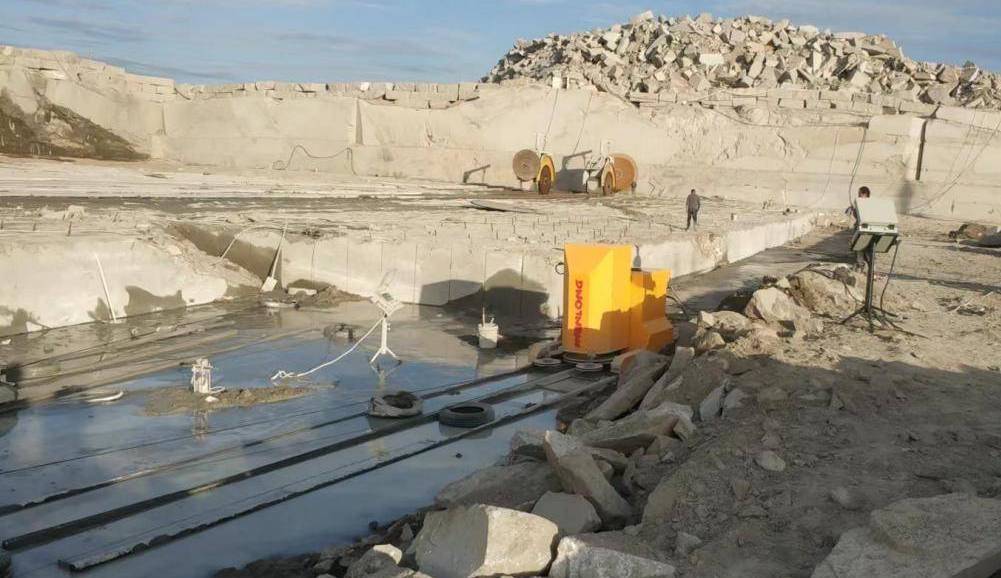
The rate at which the saw unit moves must be adjusted in real-time based on the load status of the main motor and the required tension of the saw wire. If the movement speed is too high, the load on the main motor will increase rapidly—potentially leading to an overload—while the tension on the saw wire will also rise; failure to adjust the speed promptly in such instances may result in the saw wire snapping.
Conversely, if the movement speed is too slow, the tension on the saw wire will drop sharply. This causes the wire to slip against the stone, thereby reducing cutting efficiency; furthermore, a slack wire is prone to twisting—a condition that can ultimately lead to the wire severing itself.
The key to effective control lies in maximizing the saw machine's cutting efficiency while simultaneously maintaining a relatively uniform load on the main motor and ensuring appropriate tension in the saw wire. Given the irregular shapes inherent to quarries and rock formations—resulting in naturally varying cross-sectional areas—the movement speed of the saw unit must be adjusted dynamically and in a timely manner.