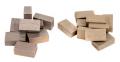

The production process of diamond segments primarily consists of several stages: mixing, stirring, cold pressing, molding, sintering, and post-processing before becoming finished products. Among these steps, today we will focus on the cold pressing process.
What is Cold Pressing?
Manufacturers with the resources often design cold pressing workshops as air-conditioned rooms. However, many manufacturers do not prioritize this, so most cold pressing operations are conducted at room temperature. The specific method involves applying pressure to the mixed powder (containing diamond particles and matrix material) to compact it into a block. This cold pressing process enables the initial bonding of diamonds and matrix, forming the segment shape. It can be said that cold pressing is a crucial step in segment shaping.
What machinery is used for cold pressing diamond segments? Currently, most domestic manufacturers employ fully automated cold press machines. These machines offer high processing efficiency, requiring only one operator to weigh the finished products (a critical step).
Weighing is a vital part of the cold pressing process. Excessive or insufficient weight can lead to quality issues in the segments. Ensuring consistent weight across a batch is crucial, as weight variations primarily result from uneven distribution of diamonds and the bonding agent. Such unevenness causes significant deviations in segment quality, which must be avoided during production.
So, how can uniformity of the powder be ensured during cold pressing?
The initial mixing stage is critical. Inadequate mixing is the primary obstacle during cold pressing. Beyond powder quality, the issue of diamond raw materials also plays a role. Using low-quality diamonds or diamond powder with inconsistent particle sizes will inevitably lead to uneven powder distribution.