
How Does a Diamond Wire Saw Cut Marble?
A diamond wire saw uses a continuous diamond wire as the cutting tool. The wire is fitted with diamond segments that remove marble as the wire moves through the block.
Unlike a conventional circular saw blade, the wire is not limited by a fixed blade diameter. This allows it to cut large blocks and work on stone surfaces where a circular blade would be difficult to use.
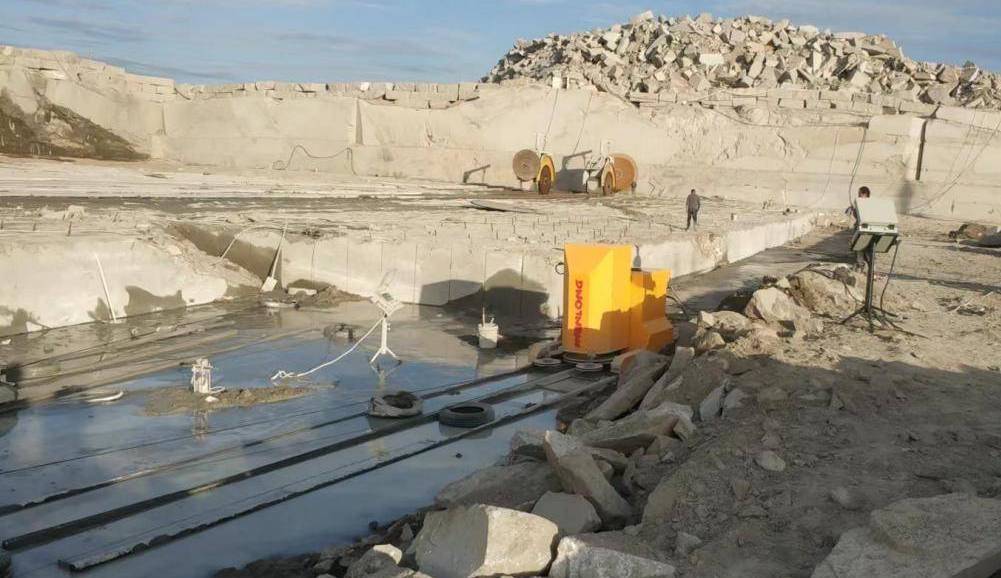
In a marble quarry, the machine guides the wire through pre-drilled holes or an established cutting path. As the wire travels around the stone, the diamond segments gradually cut a groove through the marble.
The basic cutting process involves:
1.Positioning the wire around the section to be removed.
2.Starting the wire saw and bringing the wire to the required operating speed.
3.Applying controlled wire tension and feed.
4.Allowing the diamond segments to cut through the marble.
5.Monitoring the cutting path, wire condition and stone movement.
6.Completing the separation and removing the finished block.
The actual parameters depend on the marble, block size, wire specification and machine configuration.
Why Is the Cutting Sequence So Important?
Cutting a large marble block is not simply a matter of running the wire until the stone separates.
The order of the cuts can affect how the remaining stone supports itself and how the wire behaves near the end of the operation.
For many quarry cutting situations, horizontal cutting is completed before vertical cutting.
A simplified sequence can be understood like this:
Horizontal cut → Vertical cuts → Final separation
The exact sequence can vary according to the quarry layout, block shape and cutting method, but the basic principle is to control how the stone is supported throughout the process.
Why Make the Horizontal Cut First?
When the horizontal cut is completed first, the stone structure and the remaining support are easier to control during the following vertical cuts.
If the vertical cuts are completed first and the horizontal cut is left until the end, the remaining stone can behave differently as the final section is removed.
This can create several problems:
● The marble may crack or break unexpectedly.
● Part of the stone can move and put pressure on the wire.
● The wire can become trapped in the cutting groove.
● Wire deformation may occur.
● The machine may continue running without producing normal cutting progress.
For this reason, experienced quarry operators generally plan the cutting sequence before starting the machine rather than deciding the order during operation.
What Can Happen If the Order Is Wrong?
One common problem is wire trapping.
When the stone moves or closes around the cutting groove, the wire may lose its normal running condition. The motor can still be running, but the wire may no longer move through the stone as it should.
This can result in:
Stone movement → Wire pressure → Poor wire running → Wire deformation or damage
In more serious cases, the operator may need to stop the machine and deal with the trapped wire before continuing.
This is one reason cutting sequence should be considered together with block stability, stone structure and the planned direction of separation.
Diamond Wire and Diamond Wire Saw Are Not the Same Thing
These two terms are often used interchangeably, but they refer to different parts of the cutting system.
| Term | Meaning |
|---|---|
| Diamond wire | The cutting tool containing diamond segments |
| Diamond wire saw | The machine/system that drives, tensions and controls the diamond wire |
| Diamond segments | The diamond-containing cutting elements attached to the wire |
| Marble block | The rough stone block being separated or shaped |
This distinction is useful when discussing quarry equipment, replacement wire or cutting performance.
For example, a quarry may need to select the right diamond wire according to the marble type, while the diamond wire saw must provide suitable speed, tension and movement control.
Where Is Diamond Wire Cutting Used in Marble Quarries?
Diamond wire technology is particularly useful when the stone is too large or the cutting geometry is unsuitable for a conventional circular blade.
Typical applications include:
| Application | Purpose |
|---|---|
| Large marble blocks | Separating large sections of quarry stone |
| Rough block extraction | Cutting blocks from the quarry face |
| Primary quarry cutting | Creating the main separation surfaces |
| Irregular stone | Cutting where a circular blade has limited access |
| Curved cutting | Producing curved or special-shaped stone |
| Profile cutting | Following a planned cutting shape |
For quarry production, the machine and wire need to be selected according to the stone characteristics and the intended cutting method.
Can a Diamond Wire Saw Make Curved Cuts?
Yes. One of the advantages of diamond wire cutting is its flexibility.
Because the cutting tool is a flexible wire rather than a rigid circular blade, the system can be used for certain curved, arc-shaped and special-profile stone cuts.
The actual cutting capability depends on the machine structure, wire arrangement, control system and required profile.
For more complex shapes, computer-controlled movement can be used to guide the wire along a predefined cutting path.
This makes diamond wire technology useful not only for straight quarry cuts but also for some special-shaped stone processing applications.
What Should Operators Watch During Cutting?
A stable cutting operation requires more than simply starting the machine.
Operators should pay attention to:
● Wire running condition
● Wire tension
● Cutting speed
● Machine feed
● Cooling water
● Stone movement
● Cutting groove condition
● Abnormal vibration or noise
● Changes in cutting resistance
● Wire wear or deformation
If the wire suddenly stops cutting normally, continuing to increase feed is not necessarily the solution.
The operator should first check whether the wire is trapped, whether the stone has moved, or whether another part of the cutting system has changed.
A Simple Cutting Sequence for Marble Blocks
For a typical block-separation operation, the process can be viewed as:
1. Plan the cutting path
Determine the required block dimensions and cutting direction.
2. Prepare the wire path
Set up the diamond wire according to the machine and quarry conditions.
3. Make the horizontal cut
Complete the planned horizontal separation while maintaining stable wire operation.
4. Continue with the vertical cuts
Cut the remaining sides according to the planned sequence.
5. Monitor block movement
Watch for changes in the stone position as the cuts approach completion.
6. Complete the separation
Finish the cut without allowing the stone to trap or deform the wire.
7. Inspect the block and wire
Check the extracted block as well as the condition of the diamond wire before the next operation.
The actual procedure should always be adjusted to the specific quarry conditions and equipment.
Frequently Asked Questions
What is a diamond wire saw used for?
A diamond wire saw is used to cut stone and other hard materials with a flexible diamond-embedded wire. In stone quarries, it is commonly used for large blocks, quarry-face cutting and applications where a circular blade is not suitable.
Why is horizontal cutting usually done before vertical cutting?
The horizontal cut is normally completed first to help control the remaining stone structure during the following vertical cuts. The sequence can reduce the risk of unexpected stone movement, wire trapping and wire deformation.
What happens if the diamond wire becomes trapped?
The wire may stop moving normally even though the machine motor is still running. Continuing to operate under these conditions can damage or deform the wire. The machine should be stopped and the cause investigated before cutting continues.
Can diamond wire saws cut curved marble?
Yes. Diamond wire systems can be used for some curved, arc-shaped and profile cuts. The achievable shape depends on the machine, wire arrangement and control method.
Is diamond wire the same as a diamond wire saw?
No. Diamond wire is the cutting tool, while a diamond wire saw is the machine or complete cutting system used to drive and control the wire.
What Matters Most When Cutting Marble Blocks?
Successful marble block cutting depends on more than wire quality alone. The cutting sequence, stone stability, wire condition, machine control and operator judgment all affect the result.
For large quarry blocks, planning the cutting direction before starting the machine is especially important. In many applications, completing the horizontal cut before the vertical cuts helps keep the block stable and reduces the chance of trapping or deforming the diamond wire.
For this reason, diamond wire selection and machine selection should be considered together rather than treated as two separate decisions.