
Both problems pushed manufacturers toward a more controlled approach, one that lets a mold be reused many times, lowers the sintering cost per segment and, in turn, the price of the segment. The result is a staged sequence: cold press, heat, press at temperature, then cool.
Stage 1: Cold pressing the blank
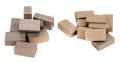
Cold pressing, also called pre-pressing, takes place before any heat is applied. The working layer and non-working layer of the segment are placed in a mold and compacted in a manual or automatic cold press.
The pressure depends on the formulation. A mix with a lot of paraffin or low-melting-point metals needs higher pressure, and other mixes can use less. The usual range is 1,000 to 2,000 kg/cm? (about 98 to 196 MPa).
The pressed blank is made close to its final thickness in one direction. The other dimension is left slightly oversize, which gives the later hot pressing some material to compress.
Stage 2: Heating in the graphite mold
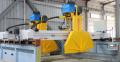
The cold-pressed blanks go into a graphite mold, which is loaded into the hot press. The press switches on its heating current and brings the mold to sintering temperature.
This heating period is the first part of the sintering cycle. The cycle does not end at peak temperature. It continues until the mold has cooled back to room temperature, which makes it a long process.

Stage 3: Pressing at sintering temperature
Once the mold has reached sintering temperature and been held there for a period of time, pressure is applied. The high pressure bonds the working layer and non-working layer together. When the segment has been pressed to the target size, pressure and temperature are both reduced.
Applying pressure after the temperature hold, rather than together with the first heating, is the key difference from the early method described above.
Stage 4: Cooling and demolding
The mold is set on a steel plate and cooled to room temperature. Only then are the segments taken out for finishing and quality inspection.